Category: Uncategorized

  • How do I help my Child Build Self-Confidence?

    How do I help my Child Build Self-Confidence?

    Confidence Isn’t a Personality Trait …

    Many students believe confidence is something you either have or don’t. They look at confident peers and assume it’s personality-based — something natural, effortless, and out of reach.

    But when it comes to careers, that belief couldn’t be more misleading.

    Career confidence is not about being loud, outgoing, or fearless.
    It’s about competence — knowing you can handle challenges, learn quickly, and respond effectively when things don’t go perfectly.
    And here’s the most important part:
    You don’t need a job to start building career confidence.

    You can start long before you ever submit your first application.

    The Real Source of Career Confidence

    Confidence doesn’t come from reassurance or motivation alone. It comes from evidence.

    Students feel confident when they’ve:

    • Tried something challenging
    • Figured things out
    • Made mistakes and recovered
    • Seen themselves improve

    This is why confidence grows through experience, not intention. Telling yourself to “be confident” rarely works. Doing confidence-building work does.

    Career confidence is the result of repeatedly proving to yourself that you are capable.

    What Is Career Competence?

    Career competence is the ability to function effectively in real-world professional environments. It includes:

    • Communication
    • Problem-solving
    • Teamwork
    • Time management
    • Professional behaviour

    Competence answers the question:
    “Can I handle this?”

    When students develop competence, confidence follows naturally.
    Why Many Students Feel Unprepared for Their First Job

    It’s common for students to feel anxious before their first job, interview, or professional opportunity. This anxiety usually comes from uncertainty, not inability.

    Students often worry:

    • “What if I don’t know what to do?”
    • “What if I say the wrong thing?”
    • “What if I make a mistake?”

    These fears exist because students haven’t had enough chances to practice professional skills in low-risk environments.

    School builds academic knowledge. Career confidence is built by applying skills, not just learning about them.

    The Key Skills That Build Career Confidence

    1. Communication Competence

    Being able to communicate clearly is one of the fastest ways to build confidence.

    This includes:

    • Introducing yourself professionally
    • Asking questions without fear
    • Explaining your thinking
    • Writing clear messages
    • Speaking up in group settings

    When students know how to communicate, uncertainty decreases. Confidence increases because they can express themselves effectively.

    2. Problem-Solving and Decision-Making

    Confidence grows when students learn how to approach problems rather than avoid them.

    Problem-solving competence includes:

    • Breaking problems into smaller parts
    • Asking clarifying questions
    • Trying solutions and adjusting
    • Learning from outcomes

    Students who practice problem-solving don’t panic when challenges arise — they engage.

    3. Teamwork and Collaboration

    Most jobs involve working with others. Students gain confidence when they learn how to:

    • Contribute ideas
    • Listen respectfully
    • Navigate disagreements
    • Share responsibility

    Knowing how to work in a team reduces fear of group environments and builds trust in one’s ability to contribute.

    4. Professional Behaviour and Reliability

    Confidence also comes from knowing how to behave professionally.

    This includes:

    • Being on time
    • Following through on commitments
    • Managing responsibilities
    • Communicating progress

    Students who are reliable feel confident because they know they can be trusted — and trust is foundational to success.

    Why Competence Must Come Before Confidence

    Many students wait to feel confident before trying something new. In reality, the order works the other way around:

    Try → Learn → Improve → Gain confidence

    Avoiding challenges delays confidence. Engaging with challenges builds competence.

    Career confidence isn’t about avoiding mistakes — it’s about knowing how to respond when they happen.

    The Power of Safe Practice

    One of the biggest barriers to career confidence is fear of failure. Students worry that mistakes will define them.

    This is why safe practice environments are essential.

    Programs like Ignite are designed to:

    • Simulate real-world expectations
    • Provide structure and guidance
    • Allow mistakes without long-term consequences
    • Offer feedback and reflection

    Students learn that mistakes are part of growth — not proof of failure.

    How Ignite Helps Students Build Confidence Through Competence

    Ignite programs focus on doing, not just discussing.

    Through hands-on experiences, students:

    • Communicate with peers and facilitators
    • Solve real-world challenges
    • Practice leadership and teamwork
    • Receive feedback
    • Reflect on their progress

    Each experience adds evidence:
    “I’ve done this before. I can handle this.”

    That evidence becomes confidence.

    How Students Can Start Building Career Confidence Right Now

    Students don’t need to wait for a job to start building competence. They can begin by:

    • Participating in experiential learning opportunities
    • Taking on responsibility in group projects
    • Practicing professional communication
    • Asking for feedback
    • Reflecting on growth

    Small steps compound quickly.

    Why Teachers and Schools Play a Critical Role

    Teachers see students daily — often before students see themselves as capable professionals.

    By encouraging experiential learning, reflection, and skill development, educators help students build confidence that grades alone cannot provide.

    Career readiness isn’t an add-on. It’s a foundation.

    Final Thought: Confidence Is Built, Not Given

    Career confidence doesn’t come from luck, personality, or perfect preparation. It comes from competence built through experience.

    Students don’t need to know everything before their first job.
    They need to trust their ability to learn, communicate, and adapt.

    That trust is earned — one experience at a time.

    And the best time to start building it is before the first application is ever submitted.

    Introducing Flashpoint Career Start Essentials: An Employment Readiness Program for Teens
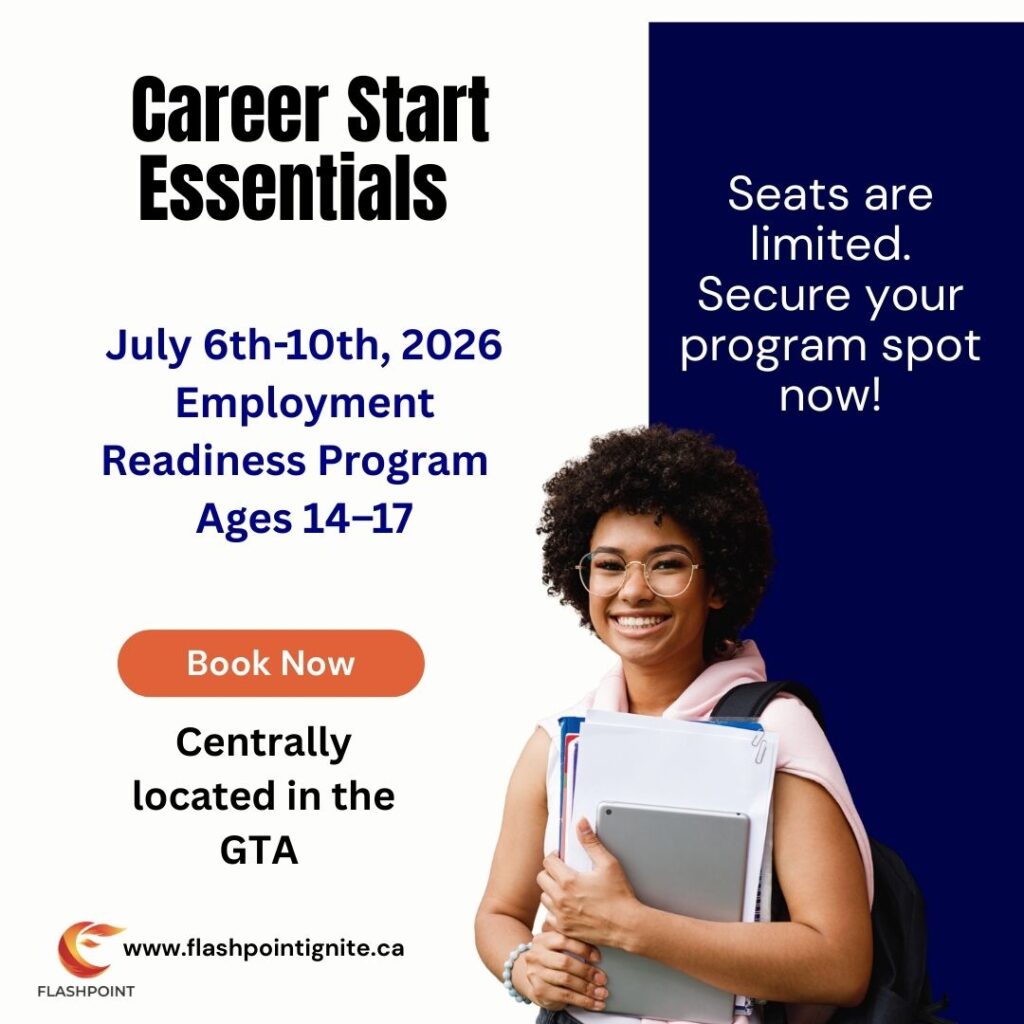
    Flashpoint offers a summer program for 14-17 year olds to help students prepare for their first job and practice key skills like self-confidence in a safe setting.

    Check out this key Job Readiness Summer Program/Camp to help your teen build their job readiness and self-confidence.

    Career Start Essentials

    ->Toronto: https://www.tickettailor.com/events/flashpointignite/2027278

    ->London:

    https://www.tickettailor.com/events/flashpointignite/2027273

  • From Student to Professional: The Mindset Shift That Changes Everything

    From Student to Professional: The Mindset Shift That Changes Everything

    Becoming a Professional Starts Long Before Your First Job

    Many students believe that becoming a “professional” happens automatically after graduation or once they land their first job. They imagine professionalism as something tied to age, job titles, or workplace uniforms.

    In reality, the shift from student to professional has very little to do with age — and everything to do with mindset.

    Professionalism is not something that magically appears on your first day of work. It’s a way of thinking, communicating, and taking responsibility that develops over time. The earlier students begin practicing this mindset, the more confident and capable they become when real opportunities arrive.

    The most successful young professionals don’t wait to be told how to act in the workplace. They start thinking like professionals before they ever apply for a job.

    What Does “Professional Mindset” Actually Mean?

    A professional mindset is not about knowing everything or pretending to be someone you’re not. It’s about how you approach learning, responsibility, and relationships.

    Professionals:

    • Take ownership of their actions
    • Communicate clearly and respectfully
    • Manage expectations
    • Respond constructively to feedback
    • Understand that their behaviour affects others

    Students often focus on what they need to learn. Professionals focus on how they show up while learning.

    This shift changes everything.

    The Biggest Difference Between Student Thinking and Professional Thinking

    Student Thinking

    • “Is this good enough to pass?”
    • “What do I need to do for the mark?”
    • “Tell me exactly what to do.”
    • “I’ll fix it if I get in trouble.”

    Professional Thinking

    • “Does this meet the standard?”
    • “How can I improve this?”
    • “What’s the best approach?”
    • “How will this affect others?”

    Neither mindset is wrong — they simply serve different environments. School rewards completion. Work rewards quality, initiative, and accountability.

    The earlier students practice professional thinking, the smoother their transition becomes.

    Mindset Shift #1: From Doing Tasks to Taking Responsibility

    One of the biggest mindset shifts is moving from task completion to responsibility ownership.

    In school, success often looks like:

    • Completing assignments
    • Meeting deadlines
    • Following instructions

    In professional environments, success looks like:

    • Understanding expectations
    • Anticipating needs
    • Communicating progress
    • Taking responsibility for outcomes

    Professionals don’t wait to be chased. They follow up. They ask clarifying questions. They take ownership — even when something goes wrong.

    This shift builds trust quickly.


    Mindset Shift #2: From Being Taught to Actively Learning

    Students are used to structured learning: lessons, assignments, tests. In professional settings, learning is often self-directed.

    Professionals:

    • Ask questions without being prompted
    • Seek feedback
    • Learn from observation
    • Reflect on mistakes

    Employers value students who show curiosity and a willingness to learn far more than those who try to appear “perfect.”

    A professional mindset says: I don’t know everything — but I’m responsible for learning.


    Mindset Shift #3: From Informal to Intentional Communication

    Communication is one of the clearest markers of professionalism.

    Professional communication doesn’t mean sounding formal or stiff. It means being clear, respectful, and intentional.

    This includes:

    • Writing emails with purpose
    • Speaking clearly in groups
    • Listening without interrupting
    • Adjusting tone based on audience

    Students who learn to communicate professionally early gain confidence quickly. They are taken more seriously — not because of age, but because of clarity.


    Mindset Shift #4: From Avoiding Feedback to Using It

    Many students see feedback as criticism. Professionals see feedback as information.

    A professional mindset understands that:

    • Feedback is part of growth
    • Mistakes are expected
    • Improvement matters more than perfection

    Students who can receive feedback calmly, ask follow-up questions, and apply suggestions stand out immediately in workplaces.

    This skill alone can accelerate career growth.


    Mindset Shift #5: From External Motivation to Internal Standards

    In school, motivation often comes from grades, deadlines, or consequences. In professional environments, motivation must be internal.

    Professionals ask:

    • “Is this something I’m proud of?”
    • “Does this reflect my standards?”
    • “What’s the impact of my work?”

    This internal shift builds confidence, independence, and credibility.


    Why This Mindset Shift Matters So Much for Students

    Students who develop a professional mindset early:

    • Feel more confident in new environments
    • Adapt faster to workplace expectations
    • Communicate more effectively
    • Handle responsibility with less stress

    Instead of feeling overwhelmed by adult expectations, they feel prepared.

    This mindset doesn’t remove challenges — it makes students capable of handling them.


    How Ignite Helps Students Practice Professional Thinking

    Ignite programs are intentionally designed to help students practice professional behaviours before the stakes are high.

    Through experiential learning, students:

    • Work in teams
    • Communicate ideas clearly
    • Manage responsibilities
    • Receive and apply feedback
    • Reflect on their growth

    These experiences allow students to try on professionalism — not in theory, but in action.

    By the time students face interviews, internships, or first jobs, the mindset is already familiar.

    How Students Can Start Making the Shift Now

    Students don’t need a job title to begin thinking like professionals. They can start by:

    • Taking ownership of commitments
    • Communicating clearly and respectfully
    • Asking thoughtful questions
    • Reflecting on feedback
    • Holding themselves to higher standards

    Small changes in mindset create big changes in confidence.


    Final Thought: Professionalism Is a Skill — Not a Switch

    Becoming a professional isn’t something that happens overnight or after a single milestone. It’s a mindset built through practice, reflection, and responsibility.

    Students who begin making this shift early don’t just prepare for their first job — they prepare for every opportunity that follows.

    Professionalism isn’t about pretending to be someone else.
    It’s about becoming the most capable version of yourself.

  • Why Grades Aren’t Enough Anymore — and What Actually Gets You Hired

    Why Grades Aren’t Enough Anymore — and What Actually Gets You Hired

    From an early age, students hear a clear message:
    “Get good grades and you’ll be successful.”

    Grades still matter. They show effort, discipline, and academic understanding. They can open doors to post-secondary education and signal that a student can meet expectations. But in today’s world of work, grades alone are no longer enough.

    Employers across industries are sending a consistent message: many students graduate with strong marks but struggle with workplace readiness. They may know the content, but they lack confidence, communication skills, professionalism, or real-world experience.

    According to employer surveys, hiring decisions today are based on skills, experience, and mindset — not transcripts alone. The question is no longer just “What grades did you get?” but “Can you work effectively with others, solve problems, and adapt?”

    So what actually gets you hired?

    What Grades Measure — and What They Don’t

    Grades are designed to measure academic learning. They show that a student can:

    • Understand subject material
    • Complete assignments
    • Prepare for assessments
    • Meet deadlines

    Those are important skills. But grades don’t always show how someone performs outside the classroom.

    Grades usually do not measure:

    • Communication in real situation
    • Teamwork and collaboration
    • Professional behaviour
    • Adaptability under pressure
    • Problem-solving in unfamiliar contexts

    In the workplace, success depends less on memorization and more on how you apply what you know.

    That’s where the gap begins.

    The Experience Gap: Why Strong Students Still Struggle

    Many students leave school academically prepared but professionally uncertain. This is often called the experience gap.

    The experience gap shows up when students:

    • Feel nervous in interviews
    • Struggle to explain their strengths
    • Don’t know how to communicate professionally
    • Have little confidence outside academic settings

    This doesn’t mean students are failing. It means the system often focuses more on assessment than application.

    Employers notice this gap quickly — especially when hiring students for their first job, internship, or co-op-style experience.

    What Employers Actually Look For When Hiring Students

    When employers review applications or conduct interviews, grades are usually only a small part of the decision. What matters more are employability skills — the skills that allow someone to function effectively in a real workplace.

    Across industries, employers consistently value:

    1. Communication Skills

    Can the student explain ideas clearly?
    Can they listen, ask questions, and respond professionally?

    2. Teamwork and Collaboration

    Can they work with different personalities?
    Can they contribute positively to a group?

    3. Problem-Solving and Critical Thinking

    Can they think through challenges rather than wait for instructions?

    4. Initiative and Work Ethic

    Do they take responsibility?
    Do they follow through?

    5. Adaptability

    Can they handle change, feedback, and new expectations?

    These skills are difficult to measure with grades — but easy to see in action.

    Why Experience Often Matters More Than Marks

    When employers say they want “experience,” they don’t always mean years of paid work. They mean evidence.

    Evidence that a student can:

    • Show up prepared
    • Communicate professionally
    • Learn from feedback
    • Handle responsibility

    This evidence can come from:

    • Career readiness programs
    • Workshops and academies
    • Leadership experiences
    • Team projects
    • Volunteer work
    • Simulations and experiential learning

    Experience gives students stories to tell — and stories matter more than numbers when it comes to hiring.

    What Actually Gets You Hired (Especially for a First Job)

    For students applying for their first job, internship, or opportunity, employers are often asking one main question:

    “Can I trust this person in my workplace?”

    Trust is built when a student demonstrates:

    • Reliability
    • Professional communication
    • Willingness to learn
    • Respect for expectations

    A student with average grades but strong communication and professionalism will often outperform a student with perfect grades but poor interpersonal skills.

    That’s not a failure of academics — it’s a reflection of real-world priorities.

    Why Career Readiness Matters Earlier Than You Think

    Many students believe career readiness starts after graduation. In reality, it starts long before the first job application.

    Career readiness means:

    • Understanding workplace expectations
    • Practicing professional behaviour
    • Learning how to communicate with adults and peers
    • Gaining confidence outside the classroom

    Programs like Ignite exist to give students these experiences early — in environments that are structured, supportive, and designed for learning.

    When students practice professional skills before the stakes are high, they enter the job market with clarity and confidence.

    How Students Can Build What Grades Can’t Show

    Students don’t need to stop caring about grades. They need to add to them.

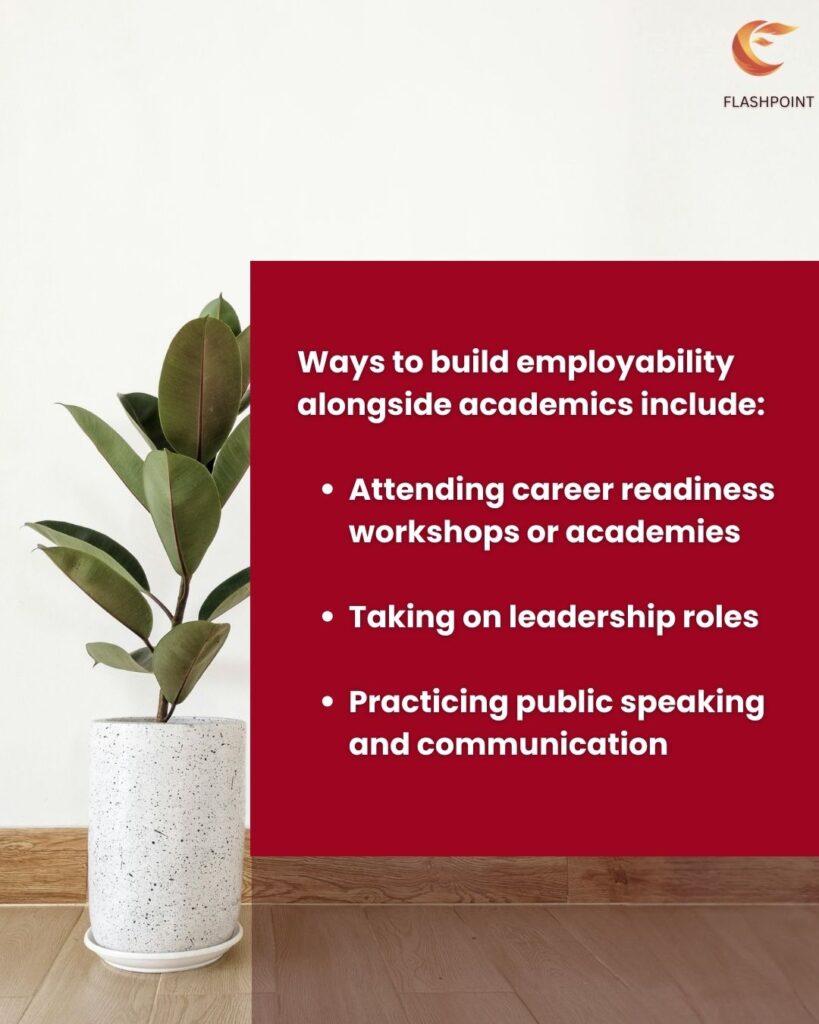
    Ways to build employability alongside academics include:

    • Participating in experiential learning programs
    • Attending career readiness workshops or academies
    • Taking on leadership roles
    • Working on team-based challenges
    • Practicing public speaking and communication
    • Reflecting on strengths and areas for growth

    These experiences help students answer interview questions with confidence — not guesswork.

    Why Ignite Focuses on Skills, Not Just Achievement

    Ignite programs are designed around a simple idea:
    success after school depends on more than marks.

    Through hands-on learning, students:

    • Practice communication and teamwork
    • Solve real-world problems
    • Receive feedback
    • Build confidence through action

    These experiences don’t replace academics — they complete them.

    Students leave Ignite programs better prepared not just to apply for opportunities, but to succeed once they get them.

    Final Thought: Grades Open Doors — Skills Help You Walk Through Them

    Grades still matter. They show effort and academic ability. But they are no longer the whole story.

    What actually gets you hired is:

    • How you communicate
    • How you work with others
    • How you solve problems
    • How you show up

    Grades may open the door.
    Skills determine what happens next.

  • Future-Proof Skills: What You Need to Learn for Jobs That Don’t Exist Yet

    Future-Proof Skills: What You Need to Learn for Jobs That Don’t Exist Yet

    Why the Future of Work Looks Nothing Like the Past

    Students are often asked a question that feels impossible to answer:
    “What do you want to be when you grow up?”

    For previous generations, this question made sense. Career paths were stable, predictable, and often linear. Students trained for a job, entered a profession, and remained in that field for most of their working lives.

    Today, that reality no longer exists.

    Many of the jobs today’s students will hold in 10, 15, or 20 years either don’t exist yet or will look radically different from what we recognize today. Job roles are changing faster than schools, job titles, and degree names can keep up.

    According to the World Economic Forum’s Future of Jobs Report, advances in automation, artificial intelligence, digital transformation, and global economic shifts are reshaping the labour market at an unprecedented pace. Entire job categories are emerging, while others are shrinking or evolving rapidly.

    This creates a critical question for students and educators alike:

    How do you prepare for careers you can’t yet see?

    The answer is not choosing a “perfect” career early.
    The answer is building future-proof skills — skills that remain valuable across industries, technologies, and job titles.

    From Job Titles to Skill Sets: How Careers Are Changing

    In the past, career success followed a predictable formula:

    Education → Job → Promotion → Retirement

    Today’s careers are far more dynamic. Most workers will:

    • Change jobs multiple times
    • Move across industries
    • Continuously learn new skills
    • Work in roles that didn’t exist when they were in school

    Because of this shift, employers are no longer focused only on what students know. They are focused on:

    • How quickly students can learn
    • How they respond to change
    • How they apply skills in unfamiliar situations

    This is why transferable skills — skills that apply across roles and industries — are now essential for career readiness.

    Future-ready students build skills that move with them.

    1. Adaptability: The Most Important Future-Proof Skill

    Adaptability is the ability to respond effectively to change — new tools, new expectations, new environments, and new challenges.

    As industries evolve, adaptability becomes more valuable than mastery of any single system or platform.

    Adaptable students:

    • Learn quickly when expectations change
    • Stay calm in uncertain situations
    • Adjust plans when needed
    • See change as opportunity rather than threat

    In modern workplaces, change is constant. New technology is introduced. Teams reorganize. Roles shift. Employers don’t expect students to know everything — but they do expect them to adapt.

    Global workforce research consistently ranks adaptability as one of the most in-demand skills for the future of work.
    It protects careers against disruption and increases long-term employability.

    2. Communication Skills Employers Still Value Most

    Despite advances in technology, communication remains one of the most important employability skills.

    Employers across industries report that many students struggle with professional communication — even when they are academically strong.

    Professional communication includes:

    • Explaining ideas clearly
    • Writing professional emails and messages
    • Speaking confidently in group settings
    • Listening actively
    • Adjusting tone for different audiences

    Strong communicators:

    • Collaborate more effectively
    • Build trust faster
    • Resolve problems sooner
    • Step into leadership roles more easily

    In a technology-driven future, communication is what keeps work human — and employable.

    3. Problem-Solving and Critical Thinking Skills

    Future jobs will not reward memorization or repetitive tasks. Machines already perform those efficiently.

    What employers need are students who can:

    • Analyze unfamiliar problems
    • Think critically
    • Generate creative solutions
    • Make decisions with incomplete information

    Problem-solving is a foundational career skill. It builds:

    • Independence
    • Confidence
    • Resilience

    Students who develop strong problem-solving skills are valuable in every sector — from business and healthcare to technology, trades, and creative industries.

    4. Digital Fluency (Beyond Basic Technology Skills)

    Digital fluency is not about knowing one app or software program. Technology evolves too quickly for that.

    Digital fluency means:

    • Learning new tools efficiently
    • Collaborating in digital environments
    • Evaluating online information critically
    • Using technology responsibly and ethically

    Digitally fluent students don’t panic when tools change — they learn. This ability keeps them employable as digital workplaces continue to evolve.

    5. Self-Management and Professional Responsibility

    As work becomes more flexible, self-management becomes essential.

    Employers increasingly value students who can:

    • Manage time effectively
    • Meet deadlines consistently
    • Communicate progress clearly
    • Take responsibility without constant supervision

    Self-management signals professionalism, maturity, and readiness — regardless of age or experience.

    Why Ignite Focuses on Skills, Not Job Titles

    Ignite programs are designed around one core principle:
    students don’t need to choose a career — they need to build capability.

    Rather than training students for a single job, Ignite experiences focus on:

    • Experiential learning
    • Team-based challenges
    • Professional communication
    • Leadership development
    • Real-world problem-solving

    These hands-on experiences allow students to practice future-proof skills in environments that feel real — but are safe for learning.

    Students leave with greater confidence, clarity, and readiness for whatever path they choose next.

    Final Thought: You Don’t Need to Predict the Future

    You don’t need to know your exact career at 16, 18, or even 22.
    You don’t need to predict how technology will change work.

    What you do need are skills that grow with you — skills that adapt, transfer, and open doors across industries and opportunities.

    That’s what it means to be future-ready.

  • How to Choose the Right Post-Secondary Program: A Real-World Guide for Students and Families

    How to Choose the Right Post-Secondary Program: A Real-World Guide for Students and Families

    For many students, deciding what to do after high school feels like standing at a huge crossroads with no clear signs. There are countless programs, new careers that didn’t exist five years ago, pressure from friends (“I already applied to five programs—what about you?”), and well-meaning adults offering advice that doesn’t always match what the student wants.

    But choosing a post-secondary program doesn’t have to be overwhelming. When you break the process into thoughtful steps and focus on what feels right for you, the path forward becomes much clearer.

    This guide walks students and families through a practical approach to exploring options, narrowing them down, and making a confident, informed decision — without the stress.

    1. Start With Yourself — Not the Program List

    Before looking at any brochures, websites, or program names, it’s important to pause and figure out who you are as a learner and what genuinely interests you. So many students skip this step and try to fit themselves into a program instead of finding a program that fits them.

    Ask yourself:

    • What classes do I look forward to? Why?
    • Which assignments or activities make me lose track of time?
    • Am I someone who prefers hands-on work or theoretical learning?
    • Do I enjoy working with people? Data? Tools? Children?
    • What kind of environment helps me succeed — structure, creativity, quiet, fast-paced, indoors, outdoors?

    This kind of self-check helps filter out programs that look good on paper but aren’t aligned with how you learn or what motivates you.

    2. Figure Out What You Want From Your Post-Secondary Experience

    Every student wants something slightly different out of their next step. Some want independence and a new city; others want affordability and staying close to home. Some want a shorter, hands-on program; others want a four-year degree with a wider range of options afterwards.

    Think about what you value:

    Program length

    • 1-year certificate
    • 2-year diploma
    • 4-year degree
    • Apprenticeship or trade training

    Location

    • Close to home?
    • Far away for a new experience?
    • Commuting vs. residence?

    Learning style

    • Hands-on labs or workshops (often college)
    • Theory-heavy lectures (often university)
    • A blend of both

    Cost

    • Tuition
    • Housing
    • Books and equipment
    • Potential scholarships

    There’s no right or wrong answer — but knowing your priorities will help narrow down your choices dramatically.

    3. Explore Programs Connected to Your Interests & Strengths

    Once you’ve done some self-reflection, you can start exploring real programs. This is where students often get excited because they realize there are programs they’ve never even heard of.

    A few ways to explore:

    Start with classes you enjoy

    Love biology? Look at:

    • Nursing
    • Environmental science
    • Biotechnology
    • Health sciences

    Interested in creativity or communication? Explore:

    • Digital media
    • Journalism
    • Design
    • Public relations

    Look at careers you’re curious about

    Even if you’re unsure of the exact job, focus on the type of work that interests you.

    Compare similar programs with different names

    For example:

    • “Life Sciences” vs. “Biology” vs. “Biomedical Studies”
    • “Computer Science” vs. “Software Engineering”

    Sometimes the difference is small — sometimes it’s huge.

    A key tip: read the first-year course list. If the courses excite you, that’s a good sign. If they feel like a chore, that program might not be the right fit.

    4. Check Admission Requirements Early

    One of the most common mistakes students make is falling in love with a program without checking admission requirements early enough.

    Make sure you look at:

    • Required Grade 11 and 12 courses
    • Minimum averages
    • Supplementary applications (portfolios, auditions, interviews)
    • Co-op or placement requirements
    • Math or science prerequisites

    Knowing this early lets you adjust your high school course plan if needed.

    5. Go Beyond the Brochure: Look at Outcomes

    Choosing a program isn’t just about the subject matter — it’s about where it leads.

    Research:

    Graduate employment rates

    Higher rates often mean strong industry partnerships.

    Job titles graduates actually get

    This helps set realistic expectations.

    Work-integrated learning

    Co-op, internships, field placements — these experiences matter a lot when it comes to getting hired.

    Professional accreditation

    Some programs lead directly to licensing (ex: nursing, early childhood education, engineering). Others require extra steps.

    Pathways between colleges and universities

    Some diplomas bridge to degrees; some degrees open doors to graduate or professional programs.

    Understanding the long-term picture makes the choice more meaningful.

    6. Visit Campuses and Talk to Real People

    You can learn only so much from a website. Campus tours, open houses, and one-on-one conversations can completely change your view of a program.

    While visiting:

    • Explore classrooms, labs, and study spaces
    • Visit residence buildings
    • Ask current students what they actually think
    • Talk to program coordinators about workload
    • Try to imagine yourself spending four months there at a time

    Sometimes students walk onto a campus and instantly feel at home. Other times, they know within minutes that it’s not the right fit — and that’s just as valuable.

    7. Build a Balanced Application List

    A smart application strategy reduces stress and keeps options open.

    Think about creating:

    • 2–3 stretch programs (competitive)
    • 3–4 target programs (realistic fit)
    • 1–2 safety options (almost guaranteed)

    Mixing colleges, universities, and apprenticeships can give flexibility — especially for students still exploring.

    8. Put Together a Strong, Organized Application

    No matter which programs you choose, the application process goes more smoothly when you prepare early.

    Students should:

    • Update their résumé
    • Gather awards, certificates, or SHSM documentation
    • Request reference letters early
    • Start supplementary materials (essays, portfolios) ahead of deadlines
    • Double-check every submission

    Parents can help with reminders and organization — but this is a great opportunity to build independence and confidence.

    Final Thoughts: You Don’t Need Everything Figured Out

    It’s important to remember that choosing a program isn’t a permanent, life-defining decision. Many students switch programs, combine college and university pathways, return for additional training, or discover new passions later. The goal isn’t perfection — it’s choosing a starting point that feels right right now.

    When students take time to reflect, explore widely, ask good questions, and consider their long-term goals, they almost always find programs they’re excited about — programs that match their strengths and help them grow.

    Your path doesn’t need to look like anyone else’s. It just needs to belong to you.

    ———

    ✅ 5-Point Post-Secondary Decision Checklist

    1. Identify what you enjoy and what you’re good at.
      Think about your favourite classes, hobbies, and strengths.
    2. Decide what matters most to you in a program.
      Length, cost, location, hands-on vs. theory, career outcomes.
    3. Explore programs connected to your interests.
      Compare first-year courses and look for programs that genuinely excite you.
    4. Check admission requirements early.
      Make sure you have the right Grade 11/12 courses and meet averages.

    Visit campuses and talk to real people.
    Attend open houses, tours, or virtual sessions to get a true feel for the program and school.

  • Creative Ways for Students to Get Their First Job: A Guide for Parents and Teens

    Creative Ways for Students to Get Their First Job: A Guide for Parents and Teens

    Landing a first job can feel overwhelming — especially when students think they need experience to get hired. The good news? There are many creative, accessible ways for young people to build skills, stand out, and step confidently into the workforce. Whether a student wants to earn money, explore career interests, or build their résumé, the strategies below can help them get started.

    Here are realistic, parent-approved ways teens can unlock their first job opportunity.

    1. Turn Everyday Skills Into Early Work Experience

    Many teens underestimate the experience they already have. Skills learned at home, school, clubs, and volunteer opportunities often translate directly to entry-level roles.

    Encourage students to list things like:

    • Helping younger siblings (childcare experience)
    • Doing chores or managing tasks (responsibility, time management)
    • School group projects (communication, teamwork)
    • Tech skills like Canva, Google Workspace, or social media

    With the right wording, these experiences can be framed as real skills employers value.

    2. Use “Micro-Volunteering” to Build Skills Quickly

    Not every student has time for long-term volunteering. Micro-volunteering — short, simple, one-time tasks — can build experience and confidence fast.

    Ideas include:

    • Helping at a community event for 2–3 hours
    • Assisting with set-up/clean-up at a school function
    • Offering to distribute flyers for a local business
    • Helping organizations with short-term online tasks

    These brief experiences can fill the résumé gaps and show initiative.

    3. Start With “Shadowing Days” or Mini-Internships

    Short-term job shadowing is one of the easiest ways for students to:

    • Explore different careers
    • Gain workplace exposure
    • Build comfort in professional environments

    Parents can help by contacting workplaces they already have connections with — dental offices, small businesses, trades companies, or community organizations.

    A single afternoon of job shadowing can become a résumé line that makes a student stand out.

    4. Tap Into Hidden Job Markets: Small & Local Businesses

    Large companies often have strict hiring requirements. But small, local businesses hire teens all the time — and often prefer motivated students they can train themselves.

    Students should consider:

    • Independent cafés
    • Local restaurants
    • Recreation centres
    • Boutiques
    • Grocery stores
    • Landscaping or gardening businesses
    • Community camps or programs

    These employers value enthusiasm more than experience and are often open to flexible schedules.

    5. Build a Simple One-Page Résumé (Even With No Experience)

    Students don’t need a long résumé — but they do need a clear, professional one.

    Include:

    • A short introductory statement
    • Skills (communication, customer service, organization)
    • Certifications (First Aid, CPR, WHMIS, Safe Food Handling)
    • School activities
    • Micro-volunteering or shadowing experiences

    Parents and teachers can help teens identify transferable skills they may not recognize themselves.

    6. Create a “Skills Portfolio” Instead of Traditional Experience

    In today’s job market, a portfolio can be more powerful than a résumé — even for entry-level jobs.

    Examples:

    • A student who likes digital design can create a small Canva portfolio.
    • A student interested in childcare can write a short “childcare readiness” summary.
    • A student who wants a retail job can create a simple list of mock customer scenarios and how they’d solve them.

    Portfolios show initiative — something employers love.

    7. Encourage Students to Ask for “Practice Shifts”

    Some small businesses will offer trial shifts, job demos, or “learn the ropes” opportunities.

    This benefits students because:

    • They gain experience instantly
    • Employers see their work ethic
    • It reduces pressure during interviews

    Parents can coach teens on how to ask confidently and respectfully.

    8. Teach Students to Network (Without Calling It Networking)

    Teens don’t usually like the word “networking.” Instead, encourage them to:

    • Tell family and friends they’re looking for a job
    • Ask teachers or coaches for recommendations
    • Ask local business owners if they’re hiring soon
    • Share a simple “I’m looking for my first job” message with trusted adults

    Most first jobs come from personal connections — not online applications.

    9. Use Social Media Wisely

    Many small businesses post hiring notices on:

    • Instagram Stories
    • Facebook community groups
    • Local job pages
    • Youth employment centers

    A student following a few local accounts can catch opportunities faster than those who wait for formal postings.

    10. Embrace Entrepreneurial Mini-Jobs

    Students can create their own “starter jobs,” such as:

    • Dog walking
    • Babysitting
    • Lawn care
    • Tutoring younger students
    • House sitting
    • Snow shovelling
    • Garage cleaning
    • Running errands for neighbours

    These jobs build confidence, create references, and often lead to more stable paid positions.

    Final Thoughts: The First Job Isn’t About Experience — It’s About Effort

    The truth is simple: employers hiring for entry-level roles aren’t looking for perfect experience — they’re looking for attitude, responsibility, effort, and willingness to learn.

    When parents and students take a creative approach, getting that first job becomes not only possible, but exciting.

    ✅ 5-Point Checklist: How Students Can Get Their First Job

    1. Use the skills you already have.
      List everyday experiences — babysitting, chores, school projects, tech skills — and turn them into résumé-ready strengths.
    2. Do quick volunteer tasks to build experience fast.
      Help at school events, community activities, or local businesses for a few hours to show initiative.
    3. Try job shadowing to gain real-world exposure.
      Spend an afternoon observing someone at work to learn about a role and gain a résumé line.
    4. Look for opportunities in small, local businesses.
      Independent cafés, restaurants, camps, and shops often hire teens with enthusiasm over experience.
    5. Create a simple résumé or skills portfolio.
      Keep it one page, include key skills, and add micro-volunteering or shadowing experiences.